Showing posts with label Reviews. Show all posts

Saturday, October 27, 2007

Daughters of the North, Sarah Hall


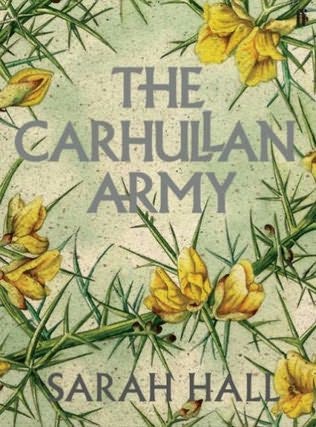
In a place where nature has proven herself more brutal than mankind and also more forgiving, 65 women forged a life close to the earth while the rest of humankind was walled off from the effects of living large upon the earth for too long. "Sister" got tired of living packed in concrete like sardines, implanted by law with a contraceptive device, factory work building machines went unused: all for a totalitarian government off fighting a coalition's war. Disappearing to the women's enclave of Carhullan she longs to find the life of her dreams, only to discover that dreams can be nightmares and what we fear can be precisely what we need. Sarah Hall has written a tract of the rawest forms of feminism: grace and passion blended with violent animalism. Unsentimental, yet gentle; sensual, yet tough and unafraid -- Daughters of the North is a must-read for every woman.

Published under the title The Carhullan Army in Britain, Sarah Hall's latest novel is slated for publication here in the states in April of 2008. But start screaming for it now. And if you can do it, order a copy from overseas, have it shipped to your door and read it before it even hits the printing presses here. It's worth it.

Synopses and British Reviews:
Twisted Sisters, Guardian Unlimited
The Book Bag
The List
Bookseller.com's Books Blog

Sunday, October 21, 2007

Out Stealing Horses, Per Petterson

This one left me speechless, gaping like a fish to find the right words of devotion to this exquisite, beautiful novel. I've been working for weeks to write up a proper review, but it isn't working. And to think, I posted about my favorite novels of late only a week before completing one that must be added to the list. I promise to find better, more accurate words of love for this remarkable, special novel that deserves a cult following into the classics.

Tuesday, April 17, 2007

Five Skies, Ron Carlson


One Idaho summer envelops the lives of three men in her broad skies, flat plains, high plateaus and dramatic silences. It is one season in the lives of the huge, silent Arthur Key; the internally raging Darwin Gallegos; and the ex-criminal but earnest young pupil Ronnie Panelli. They bond in the steely, emotionless, simple ways that men do, as they work on a contracted big-money building project in the middle of nowhere. All three men come from harsh, but not dissimilar places in life and get to know each other over dirt, plans, tools, hard work and coffee.

It is an oh-so-quiet novel loaded with a building intensity that makes like a slow-moving summer thunderstorm bound for a spectacular, wrenching finish. Ron Carlson has brought us a strong, beautiful novel of love, hope, and just doing what comes next.

Wow.

Tuesday, March 27, 2007

Three Reviews in Brief

Fresh out in hardcover, these are brief reviews of a few new books I'm recommending. The first is especially a strong contender as my favorite book of Spring.

Coal Black Horse by Robert Olmstead

A perfect, beautiful child of Cormac McCarthy and Tom Franklin, Robert Olmstead’s Coal Black Horse brings to life the bloody, horrific details that make up people and land of the Civil War while illuminating the journey of a boy and his horse: a powerful, starkly honest path leading from boy to man. The graphic, violent images are both prosaic and poetic, but the lessons are only of hope and promise. One needs to travel through hell and back in order to see the brightest lights. Wow.

The God of Animals by Aryn Kyle

What makes us finally grow up? Is it the discovery of love? Loss? Or the realization that everything is transient, sifting? More than a coming-of-age story, Aryn Kyle brings us the exquisitely wrought story of Alice Winston, a heroine in her own right, as she endures heartbreak after heartbreak over a span of time that marks her transition from child to young woman. We all have that moment in time, a span of minutes or months, that changes us forever - in what will always feel like an instant. Solid writing that is stunning to the last word, Kyle makes Alice's dark, hard world - beautiful. Just don't judge this book by its cover.

The Secret of Lost Things by Sheridan Hay

A young Australian woman emigrates to New York City only to get acquainted with a group of castaways who together shed their not-so-dull every day lives working in a used bookstore as they are caught up in a literary secret that changes their lives forever. A delightful piece of fiction that propels you forward in anticipation of what will happen next at the same time that your heart is warmed by the light that shines from the oddest of characters. This is a story about people and their connections to one another; about the families we create when we are far from our kin and how they change us forever - for the better.

Tuesday, March 20, 2007

The Reluctant Fundamentalist, Mohsin Hamid

Through the conversation of a Pakistani man and an American at a marketplace in Lahore, we learn about the recent life-changing events of a young man who leaves his home of Pakistan in order to make use of the education and opportunities in the United States. He attends Princeton and is hand-selected to work for an important firm in New York City whose sole purpose is to evaluate the financial worth of companies about to be sold, purchased, overtaken, etc. In no short order, this young man shoots to the top of his "class" within the firm, becomes someone with a lot of potential within his line of work. Then the events of 9/11 occur and change everything. Or is it the doomed relationship with an upper-class girl he meets in school that changes everything? Or is it somehow the melding of all of these things together that ultimately sheds light over a world in which our main character simply doesn't belong.

Most arresting and memorable are the changes of emotion and core beliefs that occur within our young man. His own discovery of animosity towards America, while still grateful for the opportunities he was given feels true. It is a young man who begins with hope of a prosperous future for himself in America and his family back in Pakistan, but is disillusioned by a combination of American politics and capitalism. Who's to say which had the most negative effect? Perhaps it is mostly about discovery within himself of someone who finds value in the unsayable, empathy & compassion for the least among us and realizes he cannot turn a blind eye to the harder truths of the world.

Hamid's novel is brief, simple but not without a forward-moving intensity that keeps you page-turning until you have no choice but to put the book down. And in the time between setting it aside and picking it up again, you think of it. You ponder Changez, the world he lives in now in Lahore, the world he left in New York.

The author, Mohsin Hamid, is Pakistani. He did attend Princeton and is only a few years older than his character here. Keep in mind also that Hamid began this novel in the summer of 2000, nearly a hear and a half before the events of 9/11. The voice feels just that personal, that authentic and that impassioned.

The writing is bold, precise and feels well-calculated. The sentences and images well-crafted without verging into the saccharinely poetic. The story itself builds to a climax without conclusion. Ultimately, seeing through the eyes of our protagonist and accompanying him on this journey, however brief, left me feeling quite humble.

A highly recommended read.

Visit the author's website.

Tuesday, March 06, 2007

Rant, Chuck Palahniuk

Chuck is BACK!

Using a device called the "oral biography," the story is told from the first-person perspective of many people who had some sort of contact with the main character, Buster Landru Casey, AKA "Rant". This lends itself most often to feeling as though you are listening to a radio documentary. As though someone interviewed hundreds of people one at a time, getting his or her entire version of Rant's story, then edited it together in a (more or less) chronological timeline. The voices stay fairly consistent and believable, though the reader must at times let go of the thoughts that some of these characters couldn't possibly know all that they now share about Rant's life, especially when they re-tell his childhood.

The reader gets to know the characters through their voices, through what they say as opposed to an external narrator explaining it all for you. Much in the way we experience people in everyday interactions, especially as we increase communication that is very self-centered and one-sided with e-mails, forum posts, bulletins, and of course, blogs. You judge based on word choices, sentence structure, and content. It isn't so easy to know who's the bad guy and who's the good guy. Sometimes what you think of a person based on what they say is flipped around later on by something else that comes out of the mouth.

The story itself progresses at an unstoppable pace. Impossible to put down, it still requires you to pay ever closer attention to the story being told or else you won't understand what's being told. This considering the casual use of terms foreign to us, but well-understood to the world within Rant: "Party Crashing" "flags" "tagging" "Daytimer" "Nighttimer" "boosting a peak" "neural transcripts". When the story starts turning sci-fi in technology, the reader has to start piecing together references from much earlier in the book and slow down, pay attention, read carefully in order to understand what happens. Think about what it was like for Neo to have to understand what the Matrix really was while experiencing it firsthand.

Since I have a bit of an obsession with names, I have to give a nod to the fabulous names in this book: Echo Lawrence, Shot Dunyon, Bacon Carlyle, Canada Mercer, Phoebe Truffeau, Green Taylor Simms, Symon Praeger, Carlo Tiengo, Lynn Coffee, and the list goes on. The names are ingenius, inventive, original and I envy whatever neurons snap into the right places to come up with such fun uses of the alphabet.

Then there is Palahniuk's tendency to describe in detail bodily functions, bad habits and people unafraid to harm themselves in unique ways. But, unlike Haunted which seemed to want to be as disgusting as possible, causing you to flinch so much that your muscles were probably strained while reading, in Rant Palahniuk returns to the more stylized grotesque so familiar to readers of nearly every single one of his previous books. He describes what should be so gross as to make you express yourself aloud, but yet he makes it easy to swallow while still squirming a little and laughing to yourself in disgust, as opposed to being a complete turn-off. Then he takes one particularly awful event, describing it in the sort of detail that makes you squirm precisely because of its innate awfulness and does so with sensitivity and even respect.

Set for a May 1 release, Rant is classic Palahniuk with sensory overload, critical riffs on society & government, gross oddities, not too disturbing violence and a smart, imaginative exploration of culture. Always trying on different storytelling devices, characters and voices; Palahniuk isn't afraid to stray far off the beaten track in terms of contemporary fiction. His latest novel is no different. This time he goes even further to mine the sources and structures of mythologies - those tales that have been the backbone of every religion, every culture since the dawn of time.

The questions he raises are sometimes answered, but mostly aren't and lead to only more complicated queries. And that's okay, the answers aren't what this book is about. With each chapter, you realize that the present era is being stood on its head to give a look not at today, but a speculative journey off into the future today. Yes, I meant that to sound obfuscated. To quote Rant Casey: "The future you have tomorrow won't be the same future you had yesterday."
Friday, February 09, 2007

Three Cups of Tea

I never quite got around to writing about this book after I read it and I'm not sure why. I think it had something to do with wanting to write it up properly, but not having the right words to really put it all together in the larger picture of importance.

So tonight I had the honor of hosting Greg Mortenson at my bookstore for an event. We packed in somewhere around 250 people for a marvelous 90 minutes of storytelling and photos that were so rich in beauty and background. Greg was kind, mild-mannered and clearly so passionate in his mission that you know its not a spell: this man and what he is doing is for real. It's hard not to get caught up in it all. It's so important!

This is the general way I summarize the book to customers when they come in and I recommend it:
So this guy, Greg, was raised in Tanzania by parents who built hospitals. He joined the army, went to college, became a nurse. He climbed mountains. After a "failed" attempt to climb K2 he wandered into a small village in the Karakoram mountains in Pakistan (where K2 is located). They essentially nursed him back to health. He "repaid" their debt by returning a few years later and building them a school (for a whopping $12,000 plus a bridge, it's complicated, read the book). 1 kidnapping, 2 fatwahs, 1 permissive decree from the Shariat court of Islamic clerics, 1 tribal shootout, several languages and 13 years later, Greg has facilitated the building of 58 schools. All of them are in rural areas of Pakistan and Afghanistan. For each school that is built in these impoverished communities, that is one community more that will not be sending its young boys off to Islamic Madrassas to learn the militant forms of Islam that lead to terrorism. This doesn't even count the teacher training programs, water projects, assistance within refugee camps and so much more.

Wow, right? That's just the start. The book itself reads like a part adventure, part travel literature, part societal exploration, part memoir in a way that makes you become a believer. But it isn't the book's words or the writing of it that gets your fire going, its the story itself. The story of what one man has done and continues to do with the right combination of strength, resilience, flexibility, respect, resolve and oh so much compassion and understanding of a need: a need that has a ripple effect which is immeasurable. One person CAN make a difference. A massive one, at that.

Take a moment to check out Three Cups of Tea at your local bookstore and your world will be changed. If you aren't able to support your local, independent bookstore then (*gulp*) click on this link to buy from Amazon and they will donate up to 7% of purchases to the Central Asia Institute to help continue the mission of education.

Then go to the website for the organization that makes it all happen: Central Asia Institute and consider making a donation. A pencil costs a penny. School for one child costs $1 month per child. A little goes such a long, long way.

Tuesday, November 21, 2006

Smonk, Tom Franklin

It was the eve of the eve of his death by murder and there was harmonica music on the air when E.O. Smonk rode the disputed mule over the railroad tracks and up the hill to the hotel where his trial would be.

And so begins this fabulous tale of the new mythology of Smonk, Evavangeline, Phail Walton, William R. McKissick Jr., and the entire town of Old Texas. The characters are truly unforgettable, as is the riding. What makes them unforgettable is not their commonality but the believable unbelievableness of who they are, the choices they make and how purely unredemptive most of them are. You don't have to like Smonk, though you might find yourself drawn to him in ways you can't quite explain. With his odd shape, his massive goiter, glass eye and more disgusting behaviors than can be listed here. You know you shouldn't care for Evavangeline; the surprisingly naive, violent, 15yr old whore who can't retain her rage when she drinks and yet finds herself allowing some hormone-driven actions with McKissick Jr. in a simple, openly heartfelt way of caring for him and a gaggle of orphans. McKissick Jr., possibly fated to be an outlaw no matter what chances he is given at a new life, proving that nature is often more powerful than nurture. Phail Walton: the head of the Christian Deputies who is so faithful, so devout that he drinks urine and slams his fingers in a drawer rather than feel the slightest feelings of lust and is also utterly, perhaps hopelessly, naive in his attempts to educate the near-outlaws who follow him.

It is not only superbly crafted as its sentences are nearly all worth reading aloud (and in fact, should be) but the imagery is so precise that you find it lodged permanently in your brain. Which, normally, is a wonderful thing for a novel to possess! Unless, like in Smonk, the imagery is so violent that the images can be disturbing to people who may focus more on that than on the gorgeously crafted prose that makes up every single page from start to finish.

It's edgy, rough debauchery that swirls like a prickly tumblewood flying across a desert; dark humor that tempts you not to laugh aloud; bleak beauty that is found in the hearts of even the worst characters: I am hopelessly, madly in love with this remarkable book. Though not for everyone, if it is for you then it will lodge itself on your shelf for years to come with many required rereadings. And reread you will.

Tuesday, October 03, 2006

The Road, Cormac McCarthy

Sometimes you come across a book that truly keeps you riveted. Not only while you read it, but for days after. McCarthy's apocalyptic vision does just that. I feel as though I cannot do this book any justice by writing properly formulated sentences. So much of my reaction is visceral, that a well-crafted paragraph will only take away from the impact such a work has on the mind and soul. So I give you scattered thoughts, emotions and perceptions. To know anything more, you need to read it yourself.

Fear. Chilling. Cold. Stark. A picture, a reality, voice of my nightmares. Desolate. Barren. Why worry about the boy’s heartbeat when every other thought is about mercifully killing him? Why be worried about him succumbing quiet, peaceful in the night when the other options are so much worse? What are they hoping for? What does their hope lie in? Why keep faith? What are they trying to survive for?

We long for absolute silence and the peace of not having anyone around. But if that were really to occur, we would be desolate within ourselves. We would be driven mad by every sound.

What did this? Nuclear holocaust? Meteor? Climate change?

Are the “bad people” bad for surviving in the only ways they know how? Why do they resort to cannibalism to appease their need for meat rather than learn how to plow the fields and plant things? Is the earth so scorched that nothing will grow? What will happen to the planet when all is gone? When all humanity, all animal life is gone...what will populate the earth? Lots and lots of trees? Nothing can appear from nothing. Can it?

McCarthy makes things happen when absolutley nothing is happening. How can so much happen when the world is so dead? Very few writers can paint such visions with so few words. This is one of them.

Thursday, September 07, 2006

American Bee, James Maguire

The dust jacket of this book is all you need to read to suck you inside in an instant. I could not not open the book and start from the beginning. It captures you like the peak, tense denoument of any thrilling movie or riveting sports event. And it's only a spelling bee!

Eagerly I dove into American Bee wanting to know...did David Tidmarsh win? Or did he hyperventilate and collapse onstage? How does this exciting moment, making up only the first chapter, constitute a book-length exploration of the spelling bee? As I read onwards, new questions sprang to mind: How did the bee become so huge? When did ESPN decide it was a worthy sporting event for their discriminating network to cover? Have the words always been so obnoxiously difficult? When did spellers start studying word etymology rather than simply memorize spellings? And so on.

Maguire not only answers all of these questions, but goes into a fascinating history of the spelling bee itself (social construct for young men and women to safely flirt with one another on wintery evenings in the 1800s), individual profiles of champions (several profiles covering the last 30+ years of spelling) and even into the history of orthography (spelling) back to the beginning throes of english. To think that our own dictionary, our modern spellings and fleshed out language, only truly became such 200 years ago is actually quite stunning in light of how many years society has existed and communicated to one another.

I love that Maguire makes all this so accessible that even a non-word geek would appreciate the fascinating bits of trivia and lingual history. I know this because I have been reading parts aloud to my spouse who does not, does not read, at all. He has been amazed at just how interesting this information is to him. Sure, we can read about the history of the english language and learn all about roots, outside language influences, the creation of the dictionary, etc. in other, lengthier, more academic tomes. But! But it would not be nearly as interesting to non-linguists, non-writers and non-orthographers. That's the spark of American Bee. What it takes to make what is seen as boring, interesting, is the skill of a talented storyteller.

Of course, the peering into the lives of kids who are so atypical and finding out what a broad cross-section of cultural and educational and class the Bee cuts into...that is the essence of a great history. The first national spelling bee near the start of the 20th century was won by a young girl who was, gasp, black. A black girl? You can imagine the tizzy into which society was thrown after that. Yet it stands as a perfect example of how the Bee progressed, culturally. Color-blind, gender-blind, the Bee only has ever focused on pure hard-work, intelligence and passion. Yes, passion. Wait until you read about these kids and the hours they put into learning about word roots, learning other languages and voraciously devouring anything they can read. It's enough to inspire someone to get out there and do the same, even "late" in life.

Who doesn't have an intense involvement with the spelling bee they lost? Who doesn't remember the word they mispelled and placed lower than first? I know I remember the word that brought me 3rd place in the school-wide bee I participated in as a 4th grader. Bacterium. I spelled it right in my head and raced through it, forgetting the "u". It ruined me for future bees. I guess I just didn't have what it takes. Did you?

Tuesday, July 11, 2006

Brief History of the Dead Redux

I have been madly in love with this book since I read it after it first came out and I try to handsell it like crazy (though clearly I can't do it while I'm at a camp in the WI Northwoods). Anyhow, I came across this profile of it on Nancy Pearl's list today on NPR and this is a great summary. Just thought it would be something to be aware of. The last paragraph sums it all up perfectly.

------------------
It's difficult to do a precis of Kevin Brockmeier's The Brief History of the Dead. First of all, it sounds depressing, which it isn't, really. Secondly, it's one of those novels that's simply unique; I can't think of another story that's even similar. The plot, laid bare, is this: There's a worldwide epidemic due to an out-of-control synthetic virus that is inexorably leading to the end of humankind.

Sounds like a thriller, right? But the plot itself is almost incidental to the book's theme, which really concerns the quite literal power of memory. In the world of this novel, when someone dies, they go to some other, intermediate place, where they remain so long as there is someone alive who remembers them. When they no longer exist in the memory of anyone living, they disappear.

But again, Brockmeier doesn't mean this metaphorically -- in this intermediate place are ordinary people living their quotidian lives, publishing newspapers, falling in love, regretting the past, anticipating the future. In alternating chapters, we also get the story of Laura Byrd, who's part of a scientific team in the Antarctic. How these two seemingly disparate stories intersect gradually unfolds as the novel progresses. This is the kind of book you'll find yourself thinking about long after you've gone on to other novels. The writing is masterful, the ideas are provocative, and, all in all, this is a stunning achievement.
------------------

Saturday, June 10, 2006

Honeymoon With My Brother, Wisner

Ladies, ladies, do I have a single gentleman for you! He is handsome (hoo-boy is he!), charming, a little shy and a world-traveller. He is Kurt Wisner, brother to Franz Wisner who wrote the above-mentioned book. Here's a peek:


Yes, okay, so Franz is also ridiculously handsome, but he's now taken. And I can't have Kurt so he is up for grabs ladies!

So the point of this post is not to ramble on about how remarkably handsome, sweet, polite, warm and charming the Brothers Wisner are (although I could, because they are). The point is that I have yet to mention this delightful read. I offer up excuse Number One which is that I have been preparing to leave for the wilderness for the next two months, but it's still a weak explanation.

Imagine you are ready to spend the rest of your life with someone. Your job is perfect. You have a great car, a house, fabulous pay and a girl you want to have babies with. Then with only a few days before the arrival of guests from all over to attend your well-planned, fabulous meaningful wedding -- she has her brother call to tell you that she can't do it. He isn't the brother noted in the title. No. That brother encouraged the dumped one to continue with the wedding anyway, but have a party instead. It worked. And so began a rolling ball that hasn't stopped and only gets bigger and better. Franz asked his distant, but supportive brother Kurt to attend his already-paid-for honeymoon with him. And it was on THAT honeymoon that the idea came up to bank all their bucks, sell what they could, store the rest and depart on an extended honeymoon. Yes, just the two boys.

Two years and 53 countries later, they have a book, tour across the country in a VW van, recruited Tom Cruise as a fan, signed a movie deal, have another book in the works and, well, Franz has since married and become a father. WHEW! It's no easy feat to accomplish this sort of thing. You have to be incredibly open and ready for (truly) anything to be willing to ride buses and taxis in Zambia, Botswana, Kenya and Zimbabwe; drive a new Saab across the European continent from Sweden; hike in the Andes; meet the creatures of Galapagos; trek up and down Machu Picchu; cavort in Brazil and more.

Honeymoon With My Brother is less about the recovery from a dashed fulfillment of the American Dream than it is about exploring the world outside yourself. It's about how life often only gets better after you think it has gotten as bad as you think it can get. It's about reconnecting to family (old and young), about learning how the rest of the world lives, about how to survive on your own wits and instincts. It's about taking risk and following your passions. No matter the cost. For the reward can only be happiness unlike anything you had thought possible.

An easy read that leaves you with big smiles, you will want to share this book with everyone who has ever had the rug pulled out from under them. Which is just about everyone.

Thanks again boys!

Tuesday, May 23, 2006

The Yacoubian Building. Alaa Al Aswany

Aswany has woven for us a lush, rich tapestry of modern day Egyptians. Their struggles with religion, culture, sexuality and class explode into inevitable and sometimes surprising endings. This beautiful novel is both alluringly foreign and captivatingly familiar.

Guests of the Ayatollah, Mark Bowden

I'm only on page 25 but I'm hooked. Mark Bowden, author of Black Hawk Down has brought us an over 600 page exploration of the Itanian hostage crisis. His 5 years of research is evident in his accessible narrative that is detailed enough to make you feel as though you are right there while providing you with historical and character background to a depth that makes it hard to believe he wasn't there as hostage, hostage-taker, everyday observer or politician. The timing of this book with regard to Iran's stalemate with the United States is uncanny. The mentions of the historical actions of the U.S. along with the cultural misunderstandings between the two countries is quite illuminating. And frightening.

Tuesday, May 16, 2006

Water for Elephants, Sara Gruen

I had the opportunity to read this in ARC form nearly 2 months ago. Or has it been longer than that even? Anyhow, I was so excited about this book. But I couldn't say anything because it wasn't coming out for awhile yet and I'm feeling rather cruel if I post about a great book that someone might read about and forget before it is actually on the shelves. That's not fair to you, dear reader, or to the writer who gifts us with literary feasts. This is one of those books. If I recall correctly, Water for Elephants received more bookseller reviews and ratings at Booksense than any other in the history of their picks lists. It will be #1 on their list for June. I can't say I'm surprised since this gorgeous novel deserves the recognition.

So first off we meet our characters in the midst of something chaotic. It sucks you in instantly. You have to find out what is happening! But alas, we have to meet our main character (Jacob Jankowski) as he is now: old, cantankerous, frustrated with being old and more than a little sad. We love Jacob. We hate how miserable he is and wonder what sort of life he had that makes this new change so hard to cope with. This exploration into a stage in his life that changed him forever explains to us precisely why being caged like an animal is extra hard for him. Because for Jacob, that is exactly what he feels like: one of the caged animals he tried to help when he joined the circus. Accidentally, of course.

The flashes between past and present both progress forward in seamless, parallell lines. There is no awkwardness or sense of being lost in either time. Instead, we relate bit by bit as we move forward. And moving forward at a compelling pace! Once I started this book, there was nothing (except work) that could keep me from reading it. I anticipate reading it again soon now that I know what actually happens, I want to satisfy my hunger for the luscious details. The descriptions are never laborious or too poetic. Yet they are so utterly vivid that you can smell the manure and the sweat of the workers and the food tent; you can feel the heat and hear the squeaky wheels of the train as it slowly pulls away or the shouts of the sideshow callers. As a result of Gruen's intense and careful research, the reader is completely transplanted into the fading era of train circuses cris-crossing the country.

What I love most about this book is that you really get to know each character. Flaws and all. You have a slight feeling of compassion for even the seemingly cruelest characters (well, all but one really). Gruen's ability to portray basic humanity in all its complicated glories of love, jealousy, greed, cruelty and kindness is fabulous. She never over-reaches. It is a natural progression for everyone involved.

The gritty, sumptuous, magnificent writing gives us a deeply satisfying read. This one is truly an unforgettable book that you will want to go back to time and again.

Thursday, March 23, 2006

A Dirty Job, Christopher Moore

I have been in love with Christopher Moore since I read Lust Lizard of Melancholy Cove. I am ashamed to say that while I have read nearly every book he has written, I own zero. He is a writer you can read, relish and release. Kinda like fishing the eco-friendly way. What is interesting is that I read his books, including his latest, without ever really reading anything about him. I didn't go online and read interviews or even check out his website. I just loved to read him, laugh a lot, and wallow in the disturbingly quirky humor his books embody. But I didn't truly want to know anything about him. I wanted to be a fan of the books, not of the author. But since he is coming to my store and I have to interact with the man as a part of my job, I wanted to learn a little more about the actual author. I found this in an online interview which explained so much:

With a desire to do for the horror novel what the brilliantly belated Douglas Adams had done for sci-fi with The Hitchhiker's Guide to the Galaxy

I love Douglas Adams. Have loved him for over a decade. Easily. And I also love Chuck Pahlaniuk, of the literary horror genre. Combine the two and you get Christopher Moore's writing. Slightly perverse, a little cynical, but honest and very, very funny. I don't want to say that he is highbrow writing, because he's really not, but you do have to have a certain perversity to "get" his humor, just like you have to be pretty dry to "get" Douglas Adams. Other things Moore finds funny? Mil Millington, My Name is Earl, Billy Collins and The Daily Show. None of which are surprising.

So in the latest Moore book, we have some repeat characters (like the Emperor of San Francisco and his dogs) and we have new ones fashioned in the usual vein of bumbling, slightly neurotic, totally genuine men and strong, sassy, sexy women. Our "hero" Charlie Asher is a man utterly devoted to his wife and while anxious about the birth of his first child, is eager to be a daddy. When his wife dies and a strange black man dressed in mint green (Minty Fresh) appears in the hospital room with his deceased wife, Asher realizes things are about to get really weird. Weirder than he could have ever imagined, even with his overactive, paranoid imagination. And on this journey we meet Death Merchants, hellhounds, the Morrigan, glowing red secondhand store items, ballroom-gowned squirrels (sort of), and try to save San Francisco (and ultimately the world) from the rising Forces of Darkness.

Typically Moore, typically paced so that you truly do not want to put the book down until you know what happens even with the sense that in Moore's books everything turns out well in the end (or at least, things turn out as they should) and typically laugh-out-loud funny to the point of wanting to read certain blurbs to random strangers even though you know that out-of-context it just isn't nearly as hilarious: like trying to explain an inside joke. And ultimately that's what Moore feels like: one big inside joke that you wish the whole world could "get."

Eat, Pray, Love redux

Elizabeth Gilbert on NPR about this delightful read.

Thursday, March 16, 2006

Eat, Pray, Love, Elizabeth Gilbert


Join Elizabeth on her post-divorce soul-searching journey through Italy, India and Indonesia. Honest and intimate: this part travel literature, part spiritual guide is packed with humor and in-the-moment emotional discoveries. Elizabeth doesn't skimp on baring her every thought and feeling as she traverses the geography of foreign lands...and of her own self. Though written by a woman, it’s all about universal, genderless places of the heart.

The Attack, Yasmina Khadra

Being translated into English and published in May, Khadra's latest novel has been nominated for the prestigious French award: the Prix Goncourt; and has even been optioned by Focus Features for film rights. Which is not surprising in the least. The plot alone is film-worthy these days. And Focus is the best film company to approach the movie. However, trying to remain as non-judgmental politcally and religiously as the writer will likely be difficult for a movie version.

The main character, Dr. Amin Jaafari, sees his wife off to visit family. The day she is due to return there is a suicide bombing at a restaurant and it appears his wife was the martyr. While the writing is simplistic with the occasional "big word" thrown in for good measure, the doctor's desire to unearth why his wife would do such a thing when there were no hints or signs that he saw, is a desire that is felt strongly by the reader. I'm not sure if the writing is a result of the translation alone or if Khadra is simply a simple writer. Either way, it is almost incongruous to have such easy reading mixed up with such a complex story and situation. Yet Khadra manages to give a clear account of what appears to the West as an unimaginable atrocity and to what the Middle East faces as a near-daily occurrence. While the reader doesn't find empathy for the "terrorists", the author paints a pitcure of them that puts one more in touch with the realities of these choices. You are given a clearer idea of why someone might make such a seemingly far-fetched decision. And this clarity comes through the eyes of a character who also struggles with the "why" of it all.

While not overly-impressed by this book, I loved that it was easy to get through, easy to access the greater questions of why there is such conflict and turmoil; to illustrate how complicated the Middle East conflicts really are. Westerners will never truly grasp the emotional urgency that drives the people we term "terrorists", people who live lives and dream dreams and aspire to being greater than themselves: concepts that are not unclear to Americans, regardless of religious or cultural background. And this is the hardest part of all to accept. That those who are encouraging and participating in terrible acts that destroy the lives of innocent people...they are not that dissimilar to ourselves.

The Attack asks the question: "But does that make it right?" Read and answer the question for yourself.

Wednesday, March 01, 2006

Last Chance in Texas, John Hubner

What happens when you take a state like Texas with one of the most brutal sentencing judicial systems in the country and match it up with the most progressive treatment programs for the most serious of teenage offenders? What happens when you take kids who have done horrendous things, the sorts of thing that people are never forgiven for (rape, torture, murder), and give them a true second chance? When you do these things you have arrived at the Giddings State School: the punitive holding place for the worst of the worst of Texas juvenile offenders. You combine kids from all types of vicious gangs and abusive backgrounds and give them such intense discipline that most of them understand quite clearly that if they don't obey and try to improve on themselves within these helpful, encouraging yet tough walls, they will go to prison for the entirety of their sentences. As adults. Which means they are more ruined for a future than they already were.

And so we have it. The author spends some intense time at Giddings, following along with a male and female group of kids going through the school's "Capitol Offenders Program" which takes the worst of the worst of the worst at Giddings and puts them through progressive yet very intensive therapy that involves going through their painful lives and confronting their terrible crimes. They have to learn tom come face-to-face with made them who they are today, learn how to fix their thinking, forgive themselves, understand their role as victim in their lives but then to face their crime, to feel the pain they inflicted upon others and come to grips with the fact that they have no excuses for what they did, they must take full responsbility for their actions, no matter how vicitmized they were as children.

The book is tragic and educational. It is disappointing and so hopeful. Even when you reach the epilogue and you learn where all these kids are today and you see that most of them will never end up where they hope to be; the point is that they are trying. They are making conscious efforts and decisions to avoid falling into old ways of thinking and behaving. And that is where the hope comes in.

The recidivism rates at Giddings are ridiculously low. Crazy low. So low that it makes us wonder why other juvy systems in the country aren't following their example. Part of the problem is cost. It is expensive to offer these types of programs with the sorts of trained and understanding, yet tough, individuals that run them. The other part of the problem is that it's always easier to put these kids away, labelling them as hopelessly criminal without a chance to truly change. It's easier to give in to fear than it is to think they might have a way of mending themselves and, in turn, mending our society.

So readable, so accessible, Hubner writes in a manner that makes you feel like you are with him behind the one-way mirror watching and listening as these kids go through the biggest struggle of their lives: confronting their real selves. I have a few complaints about the structure of the book: what went where and why -- and also the too-brief time spent with the girls' group. But even more important is that we need to read this book and champion ways of bringing this light and hope to as many of these hopeless juvy cases as we possibly can. Otherwise, what hope is there that things will continue to get better?